
How Long Should It Take to Settle Into a Nursery?

How Long Should It Take to Settle Into a Nursery?

Starting nursery is a big milestone – for both children and parents. It’s exciting, but it can also feel daunting to leave your little one in a new environment surrounded by new people.

One of the most common questions we hear from parents is:

“How long will it take for my child to settle into nursery?”

The truth is, there’s no one-size-fits-all answer. Every child is different. Some adapt quickly, while others take a little longer to feel secure. That’s why, at Tommies Childcare, we place so much emphasis on settling-in sessions. The time we invest at the very beginning helps children feel comfortable, parents feel reassured, and lays the foundation for positive relationships that last.

How Long Does It Usually Take?

While every child is unique, it typically takes 2-4 weeks for most children to feel settled at nursery. Some may take less time, and some may need more – both are completely normal.

We usually advise parents to allow at least a month for the process. This gives children the chance to adjust gradually and ensures you feel confident leaving them in our care.

What Happens During Settling-In Sessions?

We begin with three initial sessions, though more are available if needed:

  • Session 1: About an hour, with you staying alongside your child. This is a chance for you both to get familiar with the nursery and meet the team. It’s also when we review your child’s All About Me file, so that we understand their interests, routines, comforts, and quirks.
  • Session 2 & 3: Longer stays without you present for part (or all) of the time, helping your child gradually adjust to being with us. These often include mealtimes or naps, so children experience a fuller day in nursery.

The goal is always the same: to help your child feel safe and supported as they ease into nursery life.

Why Settling-In Sessions Matter

  1. Building Trust 

    Children need time to explore at their own pace, meet new people gradually, and learn that the nursery is a safe place where their parent or carer always comes back.

  2. Building Relationships 

    Young children thrive on secure bonds. Settling-in sessions give them a chance to form a relationship with their key person and the team, so when they start full-time, they’re welcomed by familiar faces.

  3. Supporting Parents 

    It’s not just children who need to settle. These sessions help you meet the staff, ask questions, and watch your child begin to play and interact. Seeing them safe and happy gives you the reassurance you need when it’s time to say goodbye.

  4. Every Child Is Different 

    Some children settle quickly, others need more time. Offering multiple sessions means we can tailor the process to each child’s needs, giving them (and you) the support you deserve.

  5. Positive First Impressions 

    With nearly 30 years’ experience, we know the effort invested at the start pays off in the long run. By learning about your child’s routines, likes, and comforts, we can support them better from day one.

How Parents Can Prepare

There are some simple ways you can help your child feel ready for nursery:

  • Pack a bag with essentials (change of clothes, nappies, wipes, comforters, family photo if helpful).
  • Talk positively about the nursery and what they’ll be doing there.
  • For babies, make sure they can feed from a bottle if required and begin phasing out sleep habits like rocking or pushchairs that won’t easily transfer into nursery.
  • Encourage regular attendance – routine builds familiarity, which speeds up settling.

Making Goodbyes Easier

Saying goodbye can be emotional for both you and your child. Some tips:

  • Keep goodbyes short and positive – a smile and a reassuring word go a long way.
  • Avoid “sneaking out,” as it can undermine trust.
  • Trust that it’s normal for children to cry at drop-off, and that they often settle quickly once engaged in play.

Remember, you can always call us during the day for reassurance.

What If My Child Struggles to Settle?

Some children take longer, and that’s absolutely fine. The most important thing is consistency. Collecting your child early if they’re upset can make separation harder in the long run.

If your child is finding it difficult, we can arrange additional settling-in sessions and work with you to create a plan that supports them. Many of our team are parents themselves and fully understand how emotional this process can be.

In a Nutshell

Settling into nursery is a journey, not a race. Most children adapt within a few weeks, but what matters most is that they feel safe, happy, and supported. With the right preparation, consistency, and reassurance – both from you and our team – your child will soon begin to thrive in their new environment.

If you’d like to see how our settling-in process works in practice, why not arrange a visit to your nearest Tommies Childcare nursery? We’d be delighted to show you around and answer any questions you have.

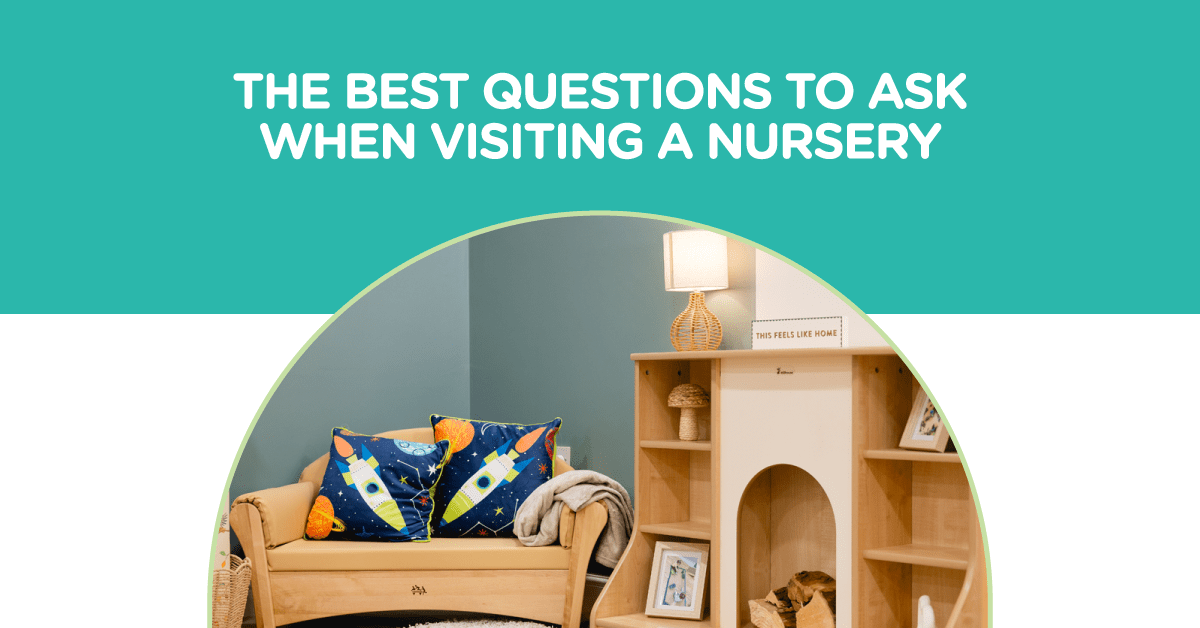
The Best Questions to Ask When Visiting a Nursery

The Best Questions to Ask When Visiting a Nursery (Parent Checklist)

For many parents, visiting a nursery for the first time can be confusing or even a little daunting.

Choosing the right nursery for your child is, after all, a big decision. You want to ensure you find out as much as possible about the nurseries you visit.

But what are the best questions to ask when visiting a nursery?

To help, we’ve compiled a list of questions you should ask (almost like having a little nursery visit checklist in your pocket). That way, you’ll be fully prepared when you start viewing nurseries.

The Best Questions to Ask When Visiting a Nursery

  • What experience and qualifications do your staff have?
  • How do you know the staff you recruit are trusted to care for children?
  • What are your fees?
  • Is there a set number of days my child needs to attend?
  • How many staff look after the children?
  • What is a key person?
  • How will you ensure my child is safe at the nursery?
  • What kinds of activities do you provide?
  • How often do children go outside?
  • How will you support my child’s learning?
  • How will I stay informed of my child’s progress?
  • Do you provide meals and snacks?
  • How do you manage children’s behaviour?
  • What do your fees include?
  • How many weeks per year is your nursery open?
  • How do you cater for children with dietary requirements or allergies?
  • What is your current Ofsted grading, and can I see the report?

“What experience and qualifications do your staff have?”

Many parents’ choice of nursery will depend heavily on the people looking after their child. After all, children will spend a great deal of time at nursery, so they must have the right people around them during their early years.

At Tommies Childcare, we believe that experience and qualifications are essential. So too is people’s work ethic and passion for childcare, and we hire people based on their ethos, not just their skills. We also provide ongoing training to all staff as part of our internal training and professional development programme.

Any staff in a management role at Tommies Childcare hold a minimum of a Level 3 qualification. Meanwhile, Nursery Practitioners will usually have a Level 2 or Level 3 qualification or have relevant experience working or looking after young children.

Recruitment has been difficult in the early years sector in recent years, and, unfortunately, this continues to be challenging. To support our recruitment needs, Tommies Childcare employs its own Bank Staff team who work on flexible contracts while fully aware of our policies, procedures and expectations.

“How do you know the staff you recruit are trusted to care for children?”

As a parent, safeguarding your child is your number one priority. This is one of the most essential questions when visiting a nursery.

A great way to determine whether staff have been checked to see if they’re suitable to work with children is to ask about the nursery’s recruitment procedure.

There are several suitability checks and processes that every nursery provider is duty-bound to adhere to. Having said that, some providers are more thorough than others.

At Tommies Childcare, we believe in taking a best-practice approach to recruitment and vetting our staff to the highest standard.

Before any new staff member can begin working at Tommies Childcare, we request to view at least two employment references and/or three years of employment history. While this can sometimes cause delays in a new team member starting work, we are committed to ensuring the above checks have been completed fully.

Additionally, we carry out an Enhanced DBS check on all staff, regardless of whether they work directly with children. DBS checks are renewed every three years or annually if the employee is registered with the DBS Update Service. We believe stringent vetting procedures are one of the simplest ways to safeguard children.

“How many staff look after the children?”

One of the more common questions is how many staff members look after the children. Specifically, what are the staff-to-children ratios?

One of the things you can do as a parent is to check that your choice of nursery is adhering to the childcare ratios outlined in the Statutory Guidance for the Early Years Foundation Stage (EYFS). An excellent way to check this is by asking whether staff cover each other’s lunch breaks. If they don’t, then that could mean that ratios are not being followed.

The statutory guidance for childcare ratios in a nursery setting is as follows. Please note that the guidance for ratios will be updated from September 2023, as shown below.

[table id=3 /]

These are the ratios that we adopt across Tommies Childcare. You may find, however, that if you visit a school nursery, the ratios are much higher. For example, for children 3+ years, where a person holds Qualified Teacher Status or Early Years Professional Status, the statutory ratio increases to 1:13. While we do have some staff working with this age group, we usually continue to operate on a 1:8 ratio.

“How often do children go outside?”

Most nurseries with outdoor space usually allow children to have regular outdoor access.

However, at Tommies Childcare, we guarantee that all children access our garden spaces daily, regardless of the weather. We promote this approach as a necessity for young children, and it is something we are passionate about. One of the reasons for this is that children gain many learning experiences from being outside, which cannot be replicated inside.

We recognise that there may be times when parents ask us if children can stay indoors if they are poorly. As outside play is one of our core values, we advise parents that children should only attend the nursery if they are well enough to participate in all activities, including outdoor play.

“How will I stay informed of my child’s progress?”

When your little one spends their day at nursery, it’s only natural to wonder what they’ve been up to — what they’ve been learning, what they’ve been exploring, and how they’re developing.

At Tommies, we want you to feel part of your child’s day, even when you’re not there. That’s why we use Famly, a simple and secure app that gives you real-time updates straight to your phone or tablet.

Our team share photos, videos, and little notes that capture your child’s learning and development, so you don’t just hear about milestones — you get to see them as they happen. You’ll also find helpful updates like what they’ve eaten, how long they’ve slept, and nappy changes, giving you peace of mind that they’re happy and cared for.

And because Famly makes it easy to message us too, you’re never out of the loop. Whether it’s sharing something from home or asking a quick question, staying in touch with your child’s nursery is as simple as opening the app.

“What is your current Ofsted grading, and can I see the report?”

The majority of childcare providers are registered with Ofsted. Your choice of nursery will likely be registered with Ofsted.

Most nurseries keep a copy of their most recent inspection report on-site, but you can also view these online and any complaints that may have been logged here.

Nursery Visit Checklist

If you’d like a printable checklist of these questions to take on your visit, download ours here.

We hope you’ve found this helpful. If you’re ready to visit one of our nurseries to ask us all these questions, find your nearest Tommies Childcare setting and arrange a visit here!


10 Things You Should Bring to Nursery

10 Things You Should Bring to Nursery

Deciding to send your child to a nursery is never easy. You may need childcare for work commitments, or you may wish your child to socialise with other children of their age outside of the family home. Whatever your reasons, the process of choosing childcare can seem quite overwhelming.

But now, it’s actually happening. Your little one is off to nursery. If you’re feeling a little nervous or anxious about leaving your child at nursery for the first time, then having as much information as possible before their first day can help to alleviate some of your worries.

To help you prepare for your child’s first day, here’s a list of 10 things you need to bring to your nursery.

1. Bag

Your child will need to bring a bag to the nursery to store all of their belongings. You can take this bag home every night, or you can feel free to leave it at the nursery if you don’t need to add anything else. Your child will have a coat peg at the nursery where you can leave their bag, coat and any other belongings. We ask that bags not be too big, as we have limited storage space at most of our nurseries.

2. Nappies, Wipes & Creams

If you have a young child who is not yet toilet-trained, it’s important that you keep a stock of any items you use at home at the nursery. We’re happy for you to bring whole packs of nappies and wipes to the nursery, eliminating the need to bring in extras each day. We label your child’s packs of nappies and wipes with their name and store them in the nappy changing areas. It is also helpful to provide us with any creams that you would like your child to have applied whilst at nursery. These can be applied as needed.

3. Coat

All children, including babies, access the outdoors every day. Whilst time outdoors may be reduced due to particularly bad weather, we do operate on the premise that children will spend time outdoors come rain or shine. Therefore, children need to have the appropriate clothing to do so. For younger and non-mobile children, an all-in-one suit may be a better option.

4. Outdoor Shoes/Wellies

All children, including those who may not yet be walking, should have a pair of outdoor shoes available to change into at the nursery. These will be used when the children go out into the garden. Wellies are great for use in wet weather and can be removed or changed when the children come indoors. Many of our parents provide their children with a set of nursery wellies that remain at the nursery at all times.

5. Spare Sets of Clothes

You may have thought that your child went through so many clothes changes when at home; however, our commitment to fun and engaging activities often results in a mess. Please ensure that you bring at least three spare changes of clothes in your nursery bag, as we cannot promise they will return home in the clothes they arrived in! For those children who have just started toilet training, more spare clothing will need to be provided. We also ask that children don’t attend nursery in their best clothes. There will be a lot of fun and messy activities taking place, so be prepared for clothes to come home marked. While we encourage the use of aprons, we know these aren’t always popular or comfortable, so children will still be able to participate without them and change if they are wet.

6. Sun Cream & Sun Hat

Parents are asked to bring in their own sun cream for their child when at nursery. This removes any issues that may occur with sensitive skin or allergic reactions. Please ensure that you keep some sun cream in your child’s bag, as the sun can sometimes make an unexpected appearance. In addition to this, please ensure that your child has a sun hat to protect them when outdoors in hot weather.

7. Extra Underwear

If your child is toilet training, it is likely that they may have accidents while at nursery. Staff will be happy to support any toilet training needs at the nursery. Please ensure that there are sufficient spare changes of underwear or clothing if your child is undergoing toilet training while at nursery.

8. Slippers

Some children may wear slippers when indoors at home. We are happy for children to wear slippers indoors if they find this more comfortable; however, for children who are walking, we advise slippers with a rubber sole to avoid any slips or accidents.

9. Comfort Item

Having a reminder from home can provide children with the reassurance they need when starting at nursery. This may be a soft toy, dummy, blanket or other familiar items. To avoid losing or forgetting the item when collecting, some parents have purchased a separate like-for-like item that can remain at the nursery.

10. Any Necessary Medication

We understand that there may be times when children will require medication when at nursery. Please ensure that if your child needs access to medication whilst at nursery, this is made available. Please ask to see our Medication and Pain Relief Policy for more information.

If you found this blog useful, why not read about how long it should take to settle in at a nursery?