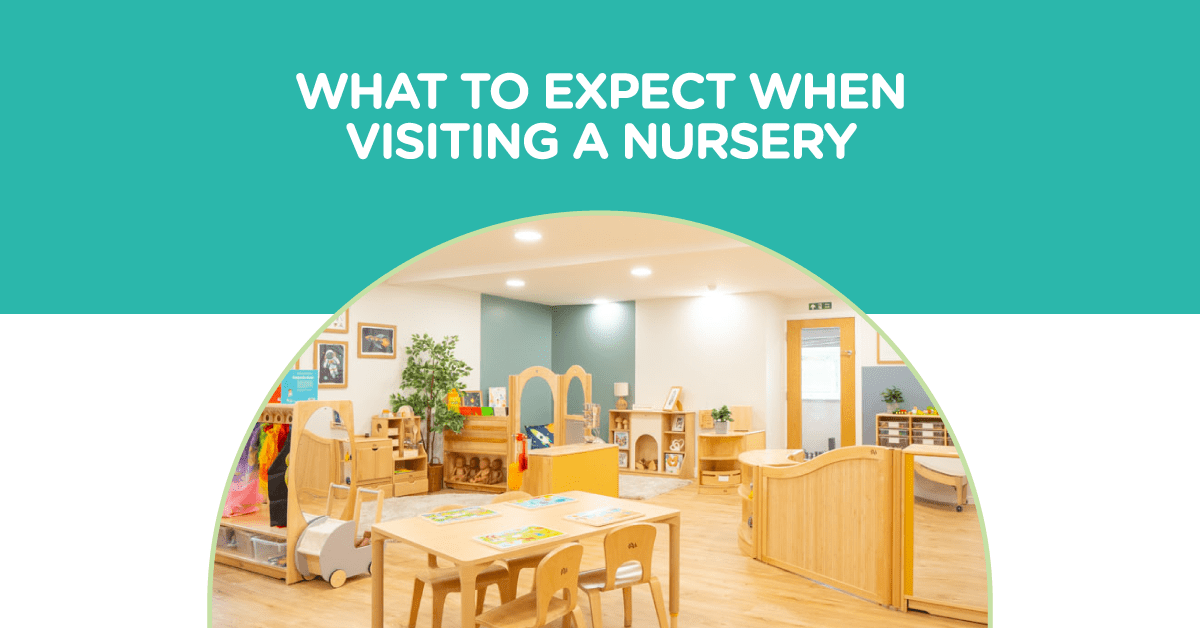
What to Expect When Visiting a Nursery

Choosing a Nursery: What to Expect When Visiting a Nursery

When the time comes to choose a nursery for your child, you will probably want to shortlist a number of day nurseries to visit. Most parents consider the following when deciding which nurseries to visit:

  • Reputation through friends, family, and within the local community
  • Ofsted rating and report
  • Review sites such as Google Reviews or daynurseries.co.uk
  • Whether older siblings have attended the nursery before
  • Proximity to home or along a commuting route

Once you have shortlisted your preferred local nurseries, you will want to reach out to arrange a nursery visit.

Making Initial Contact with the Nursery

There are several ways to contact nurseries, including via their website, phone, email, or through an online booking system. At this stage, a responsive nursery is crucial, and your experience of this may confirm or exclude some nurseries from your shortlist.

You may wish to have a conversation with each nursery on your shortlist ahead of visiting to ask about:

  • Availability, especially for younger children and baby rooms
  • Opening hours and session times
  • Pricing and fees

Availability for under 2s is often the biggest challenge for parents, with baby room places sometimes booked up to 18 months in advance. Smaller baby rooms tend to fill quickest, so early nursery visits and bookings are essential.

Visiting the Nursery: What to Expect

On the day of your nursery visit, you may feel excited or apprehensive about exploring settings that could become familiar to both you and your child. It is normal to experience a range of emotions, such as:

  • Realising maternity leave may be ending, coupled with anxiety about leaving your child in a new environment with unfamiliar people
  • Concerns about whether the nursery can provide the same level of care, love, and routine that your child receives at home
  • Worries about managing nursery drop-offs and collections alongside your work schedule
  • Apprehension about how your child will settle during their first day and beyond
  • Navigating funding arrangements, which can initially feel overwhelming

These feelings are common and understandable during this big decision-making process.

Arriving at the Nursery and What to Look For

When you arrive at the nursery, you might feel nervous, but you should expect:

  • A warm welcome from the nursery manager or designated person showing you around
  • A feeling that the nursery was expecting your arrival
  • Staff greet you and your child as you enter rooms
  • A full tour of all rooms and outdoor spaces, including outdoor play areas
  • Discussions about the daily routine, including mealtimes, nap times, and early years education curriculum
  • Information on fees, funding, and payment arrangements
  • Details on registration, key policies such as special dietary requirements, staff qualifications, including paediatric first aid training, safeguarding, and security measures

It is important to note that unless you visit outside of nursery opening hours, your visit will take place during a typical day. Nurseries try to schedule visits outside busy times, such as mealtimes and sleep times, but this is not always possible. Nurseries are busy places, and while this can feel overwhelming to new parents, it is completely normal.

Even during busy times, you should expect to see:

  • Staff interacting warmly with children and comforting those who may be upset
  • No concerns regarding children’s safety within the setting
  • Kind, welcoming, and compassionate staff attending to the children’s needs
  • Children appear happy and engaged in their environment
  • A well-maintained building free from disrepair

Choosing the right nursery is ultimately about the feeling you get when visiting the setting. The people and team you meet on the day should heavily influence your decision.

Questions to Ask During Your Nursery Visit

It’s a good idea to prepare questions in advance to ensure you cover everything important to you. Writing them down can help you avoid forgetting anything during the visit.

To know what questions to ask, you might find our post below helpful:

The Best Questions to Ask When Visiting a Nursery

Follow-Up After Your Nursery Visit

After your visit, you may receive additional information about the nursery, such as a prospectus or brochure. You should expect the nursery to contact you via phone or email to follow up within 24 hours. While some parents may not be ready to make an immediate decision, it’s important to note that nursery places are usually not confirmed until you have completed the registration process.

Early registration is especially important due to waiting lists and limited availability in popular nurseries.

By following these tips and knowing what to expect when visiting a nursery, you can make an informed choice that best supports your family’s needs, your child’s learning, development, and well-being in their new environment.

Understanding Early Years Nursery Assessments

Understanding Early Years Nursery Assessments

How Are Early Years Nurseries Assessing Children?

Assessing young children, especially those under 5, may seem unusual at first. However, in nurseries and other early years settings, early years assessments are conducted informally through ongoing observation rather than formal testing.

These assessments are a vital part of the learning and development process, enabling early years practitioners to gain a clear understanding of each child’s individual progress and needs. This ongoing assessment helps shape teaching and learning experiences tailored to support your child’s future learning and development effectively.

Parents are encouraged to engage with these assessments to recognise their child’s progress in line with the Early Years Foundation Stage (EYFS) framework, which outlines seven key areas of learning and development. This partnership between early years providers and families ensures a successful transition for children as they reach important developmental milestones.

Seven Areas of Learning (Early Years Foundation Stage)

The Early Years Foundation Stage (EYFS) framework guides us in supporting your little one’s journey through seven key areas of learning and development:

3 Prime Areas

  • Personal, Social and Emotional Development
  • Physical Development
  • Communication and Language

4 Specific Areas

  • Literacy
  • Mathematics
  • Understanding the World
  • Expressive Arts and Design

Assessments at our nurseries are continuous, with practitioners regularly observing children. The strong relationships practitioners build with each child enable them to understand the child’s interests and adapt their teaching to support children’s learning effectively.

Expectations of Early Years Assessments

Baseline Assessments

Within 6-8 weeks of your child starting nursery, your child’s Key Worker will carry out a Baseline Assessment. This statutory assessment provides an initial snapshot of your child’s level of development in line with the Early Years Foundation Stage (EYFS) framework.

The areas assessed depend on your child’s age. Children under 2 years old are assessed only on the Prime Areas of the EYFS, as these form the foundation for learning and development in the Specific Areas. Children over 2 years old will be assessed across both the Prime and Specific Areas. Following this, your child will receive a grading which reflects their progress against expected developmental milestones.

Quarterly Assessments

After the Baseline Assessment, ongoing formative assessments take place every three months to monitor your child’s progress. These summative assessments provide a clear picture of your child’s development over time. You will receive written updates, including at least one detailed assessment annually.

Each assessment highlights areas where your child may need additional support. Practitioners set targets accordingly and work closely with parents to provide guidance on supporting your child’s learning and development at home.

2-Year Progress Check

Between the ages of 2 and 3, a statutory progress check is completed in line with the Early Years Statutory Framework requirements. This check includes a short written summary focusing on your child’s progress in the Prime Areas. At Tommies Childcare, we go further by assessing both Prime and Specific Areas to give a more complete picture of your child’s development.

Read more information on the 2-Year Development Check here.

Understanding the Assessment Gradings and Your Child’s Development

When you receive your child’s assessment through our online platform Famly, each area will be graded as follows:

  • Progressing Well (Your child is demonstrating expected levels of development for their age)
  • Give More Support (Your child is making some progress but may benefit from targeted support to meet expected developmental milestones)
  • Needs Special Support (Your child requires additional support, possibly involving external health professionals or interventions, to help them progress)

It’s important to remember that some children may be demonstrating skills at home that we have not yet observed at nursery. To support accurate assessment and ongoing communication, please share home moments via the Famly app. This helps practitioners gain a fuller understanding of your child’s learning and development.

Raising Concerns Following an Assessment

If there are any concerns about your child’s development identified during assessments, these will be discussed with you beforehand. Should you feel an assessment does not accurately reflect your child’s progress, please speak to your child’s Key Worker or Nursery Manager.

We believe that assessing your child’s learning is a true partnership between our team and you. We want you to feel completely comfortable reaching out and having open conversations with us, so that together we can support your child’s development in the best possible way.

Communication with Parents

All assessments and observations are recorded and shared through our online learning journey software, Famly. Parents receive access to Famly upon registration at our nurseries. If you do not have access to your Famly account, please contact your Nursery Manager for assistance.

What Do Children Do at Nursery? Baby Room (0-1 Year)

What Do Children Do at Nursery? Baby Room (0-1 Year)

What Do Babies Actually Do at Nursery All Day?

If you’re a parent of a baby under 12 months old, you might have wondered exactly what your little one will get up to during their time at nursery. It’s a question we hear often at Tommies Childcare, and the answer might surprise you.

The Baby Room at a Tommies Childcare nursery is where the magic of early childhood education begins. Our Baby Rooms are the calmest and cosiest spaces in all of our nurseries – specially designed to meet the unique needs of babies from 6 weeks to around 12 months old. It’s a place where care, routines, and early learning experiences all come together to offer the youngest in our care the very best start in their early years.

The Baby Room Environment

Each of our Baby Rooms has been carefully designed to feel warm, secure, and inviting. We have specifically chosen a muted colour palette to create a nurturing environment that feels safe and secure.

Furniture has been specifically chosen to help children develop and reach early milestones, including crawling, pulling to stand, and taking their first steps. Rest assured, all resources in our Baby Rooms are age-appropriate and free of any choking risk.

In some of our newer and larger nurseries, you may also find dedicated sleep rooms, allowing the babies a space to sleep away from the main room. Alongside sleep rooms, self-contained milk kitchens provide our practitioners a space to prepare and serve bottles and food. That way, our Baby Rooms become self-sufficient units in our nurseries.

An image of the Baby Room at Thornhill Day Nursery in Derby. Soft furnishings, a play-mobile, and soft-play furniture adorn the room. Muted colours are used on the walls to provide calm.
Baby Room at Thornhill Day Nursery (Derby)
An image of the Baby Room at Thornhill Day Nursery in Derby. Soft furnishings, a play-mobile, and soft-play furniture adorn the room. Muted colours are used on the walls to provide calm.
Baby Room at Thornhill Day Nursery (Derby)
Cot beds in a separate Sleep Room at Shirley Green Day Nursery.
Separate Sleep Room at Shirley Green Day Nursery (Solihull)

Routines

We understand that for our youngest children, daily routines vary depending on their age and the routines already established at home. Our goal is to support both you and your child to make the transition from home to our nursery setting as smooth and nurturing as possible.

We also recognise that children move from receiving one-to-one care at home to a nursery environment where one early years practitioner cares for every three babies. To support this transition, we implement several thoughtful approaches:

  • An extended settling-in process designed to help children build positive relationships and feel secure enough to separate from their parents or carers when their nursery journey begins.
  • For babies who are exclusively breastfed but require a bottle at nursery, we kindly ask parents to prepare their child to accept a bottle before starting. This helps our nursery team effectively meet your child’s feeding needs.
  • Lastly, we request parental support in managing sleep associations that cannot be replicated in the nursery environment, such as breastfeeding to sleep, rocking, or pushchair sleep routines. While we provide reassurance and comfort during nap times, supporting these transitions at home before nursery greatly benefits your child’s ability to settle confidently in our care.

Early Learning in the Early Years Foundation Stage (EYFS)

As our babies are the youngest members of the Tommies family, we place great emphasis on nurturing secure attachments that form the foundation of their emotional development. We ensure consistency within our teams because we understand how vital stable relationships are for your child’s well-being and confidence.

Alongside building these positive relationships and supporting individual care routines, our Babies enjoy engaging in a wide variety of play-based activities designed to help them explore and develop essential skills, including:

  • Tummy time to strengthen muscles and encourage early physical development.
  • Sensory baskets filled with a variety of textures, sounds, and shapes to stimulate their natural curiosity.
  • Mirrors to foster self-awareness and early communication skills.
  • Singing songs, rhymes, and gentle stories to support early language and listening skills.
  • Daily outdoor activities, whatever the weather, to promote physical development and well-being in our nurturing nursery environments.
  • Messy play with different textures, including activities such as finger painting, playing with playdough, sand and water exploration, and using textured materials like rice, pasta, or fabric scraps. These hands-on experiences encourage sensory development, fine motor skills, creativity, and problem-solving. Messy play also supports children’s natural curiosity and helps them build confidence as they explore new sensations and express themselves freely in a safe and nurturing environment.

At such a young age, babies may be meeting other babies and children for the very first time, which is a crucial step in their social development. These early interactions help them begin to understand social cues, develop empathy, and learn the basics of communication and cooperation. Being in a nursery environment allows babies to experience sharing space and attention, which lays the foundation for positive relationships and social skills that will support their emotional growth and confidence as they continue to develop.

Social and Emotional Development

In our Baby Rooms, social and emotional development is a key focus, nurtured through a range of carefully planned activities and interactions. Babies are encouraged to build positive relationships with their key person and other nursery practitioners, fostering a sense of security and trust. Through gentle, responsive care and consistent routines, babies begin to develop attachments that are vital for their emotional well-being.

Our practitioners support babies in recognising and expressing their feelings by responding sensitively to their cues and emotions. Activities such as singing familiar songs, sharing stories, and engaging in calming sensory play help babies feel safe and valued. Group interactions, even at this early stage, introduce babies to the beginnings of social skills like turn-taking, eye contact, and early communication.

The benefits of these social and emotional development activities are profound. They lay the foundation for self-confidence and positive self-image, helping babies to feel secure in their environment and comfortable exploring new experiences. By supporting emotional regulation and early social interactions, we help babies develop resilience and the ability to form healthy relationships as they grow. This early nurturing environment also promotes a strong sense of belonging and prepares them for the transitions ahead in their early years journey.

Key Person

At Tommies Childcare, we understand just how crucial secure, trusting relationships are, especially for our youngest children. That’s why, in line with the Early Years Statutory Guidance, every child is assigned a Key Person from our dedicated team of nursery practitioners.

The Key Person builds a close bond with both you and your baby, providing consistent care and support. They also carry out ongoing assessments to monitor your child’s progress and are always on hand to answer any questions or concerns you may have. This approach helps nurture your child’s well-being and ensures they feel safe, confident, and ready to explore their early years setting with joy.

Parent Partnerships

At Tommies Childcare, we know that parents are your child’s first and most important educators. That’s why we’re committed to working closely with you throughout your child’s nursery journey. To support this partnership, we ask parents to complete an ‘All About Me’ form before their little one starts, helping us understand their unique needs and preferences right from the very first settling-in session.

Each day, you’ll receive updates through our Famly App, keeping you informed about meal and feeding times, nappy changes, sleep routines, and the exciting activities your child has enjoyed. We also love welcoming parents into our nurturing nursery environment during special events throughout the year. We hold two parent information evenings annually, where you can connect with your child’s key person to discuss their development and progress in detail.

Supporting Your Baby’s Early Years Journey at Tommies Childcare

Choosing the right nursery for your baby is one of the most important decisions you’ll make as a parent. At Tommies Childcare, we are dedicated to providing a nurturing, safe, and stimulating environment where your little one can thrive from their very first days. Our Baby Rooms are thoughtfully designed to support early development through loving care, consistent routines, and engaging play-based learning aligned with the Early Years Foundation Stage.

We understand how precious these early years are and are committed to partnering with you to give your child the best possible start. To find your nearest Tommies Childcare nursery and arrange a visit to meet our friendly team, learn more about our approach, and register your child, please get in touch with us today.

We look forward to welcoming you and your little one to the Tommies family.

When to Apply for a Primary School Place

When to Apply for a Primary School Place

For many parents, the idea of applying for a primary or junior school place once seemed far off. Perhaps it still feels like yesterday you were welcoming a new addition to your family. But now, the time has come to think about applying for primary school and plan for your child’s exciting next step in education.

Whether your child is starting primary or infant school in September 2026 or a later school year, understanding the school admissions process is essential. This guide will help you navigate key dates like the closing date for applications, explain how to choose preferred schools, and clarify what happens once the school allocates your child’s place.

From submitting your application form online to knowing what to do if you aren’t happy with the school place offered, we cover everything parents need to feel confident in securing a place at the right local school for their child. Read on for detailed information and our expert tips on ensuring your child’s step into school life goes smoothly.

When can my child start primary or junior school?

In England and Wales, children typically begin their reception year full-time in September following their fourth birthday. For instance, if your little one turns 4 in June, they would usually start school that September.

If you feel your child isn’t quite ready to start school in September, there’s flexibility. For example, if their birthday falls in August, you might choose to delay their start. However, it’s important to remember that your child must be in full-time education by the time they reach compulsory school age.

There are options to start school part-time, join partway through the year, or begin in the following academic year in September after they turn 5.

Please note: You’ll still need to apply for a primary school place at the same time as everyone else, but you can ask for a later start date when you apply.

Should your child start school after their fifth birthday, they will enter Year 1. If you’d prefer they start reception instead, it’s worth discussing this with your local council or school, but please be advised that they do not have to agree.

Compulsory school age is reached on the first of these dates after your child’s fifth birthday: 31st December, 31st March, or 31st August. If your child’s fifth birthday falls on one of these dates, that’s when compulsory education begins.

For example, if your child turns five on 31st March, they’ll need to start full-time education at the beginning of the next term, which is the summer term of that year.

Key dates and when to apply for primary school places

Parents of children whose fourth birthday is between 1st September 2025 and 31st August 2026 have until the closing date of 15th January 2026 to apply for a primary or junior school place for the academic year starting in September 2026.

How to apply for a primary school place in your local authority

You can start the application process for your nearest schools by entering your postcode on the UK Government’s website, where you’ll be redirected to your local authority’s primary school application process. Be sure to do this well in advance of the closing date.

Apply for a Primary School Place

Please note that most schools allow you to apply online, while others may require written application forms.

What are the primary school entry criteria?

You will have likely heard many parents discuss the lengths they have gone to get their child into their preferred primary and junior schools.

We all know that ‘Good’ school places are in high demand, and with fewer places available than children who need them, it can feel competitive and stressful.

Some typical school admission criteria that schools may use include:

  • children who live close to the school
  • children who have a brother or sister at the school already
  • children from a particular religion (for faith schools)
  • children who are ‘looked after’ by the local authority or have previously been ‘looked after’ and are now adopted or have special guardianship; or
  • children whose parents have worked at the school for 2+ years.

When researching your preferred schools, be sure to check their websites or social media pages, as they often post information about their specific entry criteria, which can help you assess the likelihood of your child being offered a place.

How do I choose the right primary school for my child?

What makes a great primary/junior school will depend on whether it feels like the right environment for your child.

Many parents feel pressured to choose a primary school based on academic performance, as we are regularly told that exam results are a ‘key indicator’ of a school’s success.

While academic performance, of course, holds some weight, other considerations should come into your decision-making.

Think about what you feel will best suit your child’s personality and learning style. Reflect on your interactions with the school staff and take your gut instincts into account. How did you feel when you visited a particular school?

A ‘Good’ primary school is far more about its ability to deliver a broad and balanced learning curriculum. It is more about whether you trust the staff and teachers to bring out the very best of your child.

Ultimately, you know your child better than anyone else. You know what environment they need to support their social and emotional development. Think about the things your child enjoys, whether that be sports, music, drama, or reading. That way, you can use their interests to learn more about a school’s facilities and the extra-curricular activities it offers.

Should I visit more than one school?

Yes. Definitely!

You might have one particular primary or junior school in mind as your first choice. Be prepared for it not to meet your expectations. Every school has a different ‘feel’, and you should use this to inform your decision.

Some schools might lack a certain spark or flair, while others focus entirely on academic performance. Academic performance and exam results might be your priority, which is perfectly reasonable. Still, we gently advise you to base your decision on what you believe your child will benefit from most.

During the application stage, you will be asked to list up to three or four schools in order of preference. Otherwise, you risk being offered a school at random, which could be the wrong environment for your child or be in an inconvenient location.

When will I find out which school my child has been offered?

All children’s primary school places will be confirmed by school admissions teams on or around the 16th April 2026. You’re likely to receive a confirmation email if you applied online or by post for paper applications.

You will then need to accept the offer by the deadline stated; otherwise, you risk losing your place.

What to do if you are not offered a place at your preferred school or if you are not happy

If you are not happy with the school choice offered, you have the right to appeal the decision. You can learn all about the appeal process here:

Appealing a School’s Decision

A final thought

As you prepare for your child’s exciting next step into primary school, remember you’re not alone. Many parents are navigating this transition alongside you. It’s natural to reflect on the wonderful memories and milestones reached so far. Rest assured, with your love and encouragement, your child is ready to confidently embrace the adventure of starting primary school.


Parent Wellbeing: Simple Ways to Care for Yourself

Parent Wellbeing: Simple Ways to Care for Yourself

The transition from life without children to life with children is arguably one of the greatest you’ll make in adult life. So many parents can vouch for this. But one thing we sometimes don’t pay enough attention to is parent wellbeing.

Whilst you have heard stories about having children and the joy they bring to your life, many parents don’t talk about the challenges we face both in becoming parents and in being parents.

As parents, the days can be long, and the responsibilities you carry can, at times, be overwhelming. You might find yourself constantly tuning in to how your children are feeling, managing their needs, and ensuring that they are happy, which, of course, is what we should do as parents. But while you’re busy nurturing them, it’s easy to forget that you need nurturing, too.

Parenting doesn’t come with scheduled rest or emotional breaks. It relies on your energy, your patience, and your ability to keep going, even when you feel there is nothing left in the tank.

That’s even more reason that looking after your own wellbeing is so important. It provides the foundation for everything else that happens around you. If you feel supported, well in yourself, and have a positive outlook on your life, your children will also benefit.

Why Does Parent Wellbeing Matter?

Children learn more from what we do than what we say. When they see you taking time to pause, asking for help, or setting healthy boundaries, they learn to do the same. Your wellbeing helps shape how they learn to manage stress, emotions, and self-care as they grow up.

This isn’t about aiming for perfection. It’s simply about acknowledging that being human is part of parenting. You have a child to look after, but you also have your own mental health to look after.

The NSPCC (2025) acknowledge that parents who are struggling with their mental health, without the proper support, may struggle with aspects of parenting and the challenges that naturally arise.

Feeling comfortable enough to reach out to those around you is essential when you’re struggling. This may be due to family and friends who can provide some support during difficult times. However, if you feel that further help is needed, there is a network of professionals who can help support parents, including your GP and Health Visitor.

Signs of Parental Burnout and When to Ask for Help

It’s normal to have hard days, but if you notice:

  • You feel constantly overwhelmed or exhausted
  • You have anxious feelings
  • You’re quick to snap or feel tearful
  • You can’t remember the last time you did something just for yourself or your own wellbeing
  • You’re finding it difficult to enjoy things you used to

These are signs of parent burnout, and it is time to care for your own mental health.

You aren’t failing; your needs aren’t being met. Emotional exhaustion can be tough, but recognising it is the first step towards having a conversation with someone about how you are feeling. Depending on how intense your feelings are, this could be a conversation you have with your partner, a family member or a friend.

Simple Resets for Overwhelmed Parents and Tough Times

Caring for yourself doesn’t have to be a challenge. It’s often small things that add up to a big difference.

Here are 5 simple resets to help cope with parent overwhelm or avoid parental burnout:

  1. Take A Moment: Step away from the situation that may be causing your stress levels to rise and practice slow breathing for 30 seconds. Allow yourself the opportunity to ground yourself and become present.
  2. Connection: Text or call someone who cares for you. Tell them how you are feeling. Talking out loud about your feelings can take away their power.
  3. Exercise: Go for a walk or do an activity that supports your physical health. Self-care is vital, so take some time away from your role as a parent, if you can. You’d be amazed at the difference even gentle exercise can make to your mood.
  4. Ask for Help: While this might seem like one of the hardest steps, please remember that asking for support is not a weakness. If anything, it shows strength.
  5. Do Something for You: Listen to your favourite music, read a book when the children have gone to bed, take up a hobby you may have once given up or always wanted to do, meet a friend for a coffee, or take yourself for lunch/dinner. Whatever it might be, do one thing that’s yours.

You’re Not Alone

Every parent has felt overwhelmed, unsure, or stretched too thin at some point. It doesn’t mean you’re doing anything wrong. It means you’re human and you care deeply.

If you’re facing mental health challenges, remember that support is available, and reaching out to a friend, a support group, or a professional from a mental health service can make all the difference.

You deserve wellbeing support just as much as your children do, and taking that step to ask for help is a sign of strength, not weakness.

Next Steps for Your Mental Health & Parent Wellbeing

Remember: You are doing something extraordinary, even on the days when it doesn’t feel like it.

Your own wellbeing matters. Your feelings matter. You matter.

Taking care of your own physical and mental health is essential – not just for you, but for your family too. If you ever feel overwhelmed, anxious, or struggling with your emotional wellbeing, remember that support is available.

Consider reaching out to local parents or carers groups to share experiences and find emotional support from others who understand your journey. You can also speak to your GP, health visitor, or mental health services for professional advice tailored to your needs.

For immediate help or guidance, organisations such as the NSPCC, Family Lives, or mental health charities offer resources and helplines to support parents and carers through challenging times.

Remember, asking for help is a sign of strength, not weakness. Taking time for yourself and seeking support can have a positive impact on your parenting role and day-to-day life.

You are doing better than you think, and remember that you don’t have to do it alone.

Discover More Parenting Advice

We have a whole host of other articles to support you in your parenting journey. Take a look here.

Early Years Funding Made Easy with ‘Funding Loop’

Early Years Funding Made Easy with ‘Funding Loop’

If you’ve previously had a child at a Tommies nursery, you may already be familiar with ‘Funding Loop’. If not, this guide explains what Funding Loop is and the process you’ll need to follow so we can claim your funded hours.

In order for any nursery to claim funding on a parent’s behalf, parents must complete a Parent Declaration form with the information required by the Local Authority. Funding Loop is a digital platform that helps you to do this quickly and securely each term.

“So, what is Funding Loop?”

Funding Loop is a digital system that helps parents and nurseries apply for government funding with ease. As part of the funding requirements, you’ll need to reconfirm your information each term. Using your Funding Loop account, you can do this online instead of completing paper forms every term.

“How do I access my Funding Loop account?”

Once your funding code has been provided and verified by your nursery, we’ll upload your details to our Funding Loop. This triggers an email inviting you to sign up and register. You must complete this registration to give us permission to claim your funding. If you don’t, we won’t be able to claim the funding, and it won’t be applied to your childcare bills.

“What information will I need to confirm?”

When you log in, you’ll be asked to confirm details taken from our nursery management system, including:

  • Your personal details
  • Your child’s personal details, including date of birth
  • Proof of identity (for first claims only): upload your child’s birth certificate or passport – you won’t be able to complete the form without this
  • Your child’s attendance pattern (the hours they’ll attend)
  • The number of funded hours we’re claiming on your behalf
  • Any split funding (if you’re using another provider or childminder for eligible hours)

Please note: While you may be eligible for 30 hours, we offer this over a minimum of three full days. If your child attends fewer than three full days, your claim may show fewer than 30 hours.

“What are the benefits of using Funding Loop?”

A digital platform means you can review information, see automatic calculations, and submit your form to us in a few clicks. Your completed forms and any uploaded documents are saved online for future reference and can be downloaded or printed at any time. When you complete a form for a future term, Funding Loop remembers your previous information to make the process even quicker.

“What happens after I complete the Parent Declaration?”

Once you’ve submitted the Parent Declaration, your chosen nursery is notified. We then have everything we need to add your claim to the Local Authority portal and receive payment for the funded hours you’ve authorised us to claim.

“What if I don’t complete the Parent Declaration form?”

When you register for a place at a Tommies nursery, you’re asked to read and sign our terms and conditions. All places are offered without funding because we need proof of eligibility before we can claim hours. It’s the parents’ responsibility to provide the funding code and National Insurance number as early as possible to avoid delays or invoicing errors. Once checked, your Nursery Manager will get in touch if there are any issues with the code or the information provided.

“Do I need to do anything else after completing the Parent Declaration?”

If you’re claiming Working Family Funding (30 hours), you must reconfirm your details every three months. You’ll receive an email reminder from GOV.UK before the deadline. Reconfirmation is the parents’ responsibility; failing to do so may affect your eligibility for funding.

To learn more about the types of funding available and the eligibility requirements, please click here.

6 Simple Ways to Keep Your Under 5 Safe Online

Six Simple Ways to Keep Under-5s Safe Online

The use of technology across our society has increased dramatically, and young children are using devices at an increasingly early age.

As parents and carers, the big question on our minds is:

“How do we keep our children safe when they’re online?” 

Recent UK research suggests screen use is rising and can start very early – in some cases from around six months – which means it’s worth thinking about simple, age-appropriate habits now to set children up well for an online world.

Online Learning

There are many apps that claim to support early learning – letters, numbers, shapes and more. Some are helpful, but not all are backed by strong evidence.

A good rule of thumb is to choose carefully, avoid anything that auto-plays endlessly, and explore together where you can. Co-viewing helps you talk about what your child is seeing and doing, and turns screen time into shared time.

Screen Time and Wellbeing

There has been a lot of discussion about the impact of screen time on young children’s development.

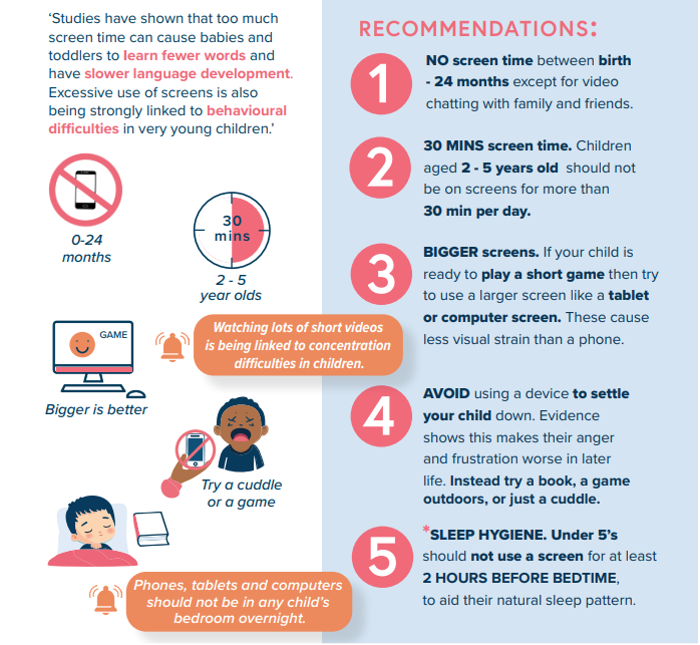
Evidence suggests (including guidance from the World Health Organisation) that children under 2 should not have access to any screen time. The possible impacts include:

  • Delayed language development
  • Difficulties with social skills
  • Sleep disruptions
  • Attention and learning difficulties

Even for children over 2, it’s sensible to place limits on screen time. Prioritise active play, conversation and good sleep routines; keep screens purposeful and short; and where possible, watch together.

The image below shows guidelines for screen time by age (Health for Under 5s):

Do It Safely

If you do choose to let your under-5 use screens, it’s worth considering the following to help them do so safely. These 6 trips draw on advice from the NSPCC:

  1. Supervise use. Under-5s should use technology with close support from a parent or carer, and ideally in shared family spaces.
  2. Use family devices, accounts and services. Stick to child-friendly devices and profiles, and use children’s versions of popular platforms (e.g. YouTube Kids).
  3. Check content first (and turn off autoplay). Preview apps and videos each time, and disable features like ‘autoplay’ so you stay in control of what plays next.
  4. Set up parental controls. Make use of safety settings on your home Wi-Fi, devices and accounts. These help, but they don’t replace supervision.
  5. Start safety conversations early. Short, everyday chats help children learn to ask for help if something pops up that worries them. The NSPCC’s ‘Techosaurus’ is a lovely starting point for little ones: Techosaurus (Learn more).
  6. Establish healthy habits. Keep technology purposeful from a young age – for example, choosing a short video together and chatting about it afterwards – and switch screens off well before bedtime.

A Final Thought

Above all, remember that screens are just one small part of a very big childhood.

Keep them short, shared and purposeful, with plenty of play, chat and sleep around them, and you’re doing the right things. If you’d like a hand setting up controls or choosing age-appropriate apps, speak to your nursery team — we’re always happy to help.

Together, we can keep your little one safe, curious and confident — online and off.

How Long Should It Take to Settle Into a Nursery?

How Long Should It Take to Settle Into a Nursery?

Starting nursery is a big milestone – for both children and parents. It’s exciting, but it can also feel daunting to leave your little one in a new environment surrounded by new people.

One of the most common questions we hear from parents is:

“How long will it take for my child to settle into nursery?”

The truth is, there’s no one-size-fits-all answer. Every child is different. Some adapt quickly, while others take a little longer to feel secure. That’s why, at Tommies Childcare, we place so much emphasis on settling-in sessions. The time we invest at the very beginning helps children feel comfortable, parents feel reassured, and lays the foundation for positive relationships that last.

How Long Does It Usually Take?

While every child is unique, it typically takes 2-4 weeks for most children to feel settled at nursery. Some may take less time, and some may need more – both are completely normal.

We usually advise parents to allow at least a month for the process. This gives children the chance to adjust gradually and ensures you feel confident leaving them in our care.

What Happens During Settling-In Sessions?

We begin with three initial sessions, though more are available if needed:

  • Session 1: About an hour, with you staying alongside your child. This is a chance for you both to get familiar with the nursery and meet the team. It’s also when we review your child’s All About Me file, so that we understand their interests, routines, comforts, and quirks.
  • Session 2 & 3: Longer stays without you present for part (or all) of the time, helping your child gradually adjust to being with us. These often include mealtimes or naps, so children experience a fuller day in nursery.

The goal is always the same: to help your child feel safe and supported as they ease into nursery life.

Why Settling-In Sessions Matter

  1. Building Trust 

    Children need time to explore at their own pace, meet new people gradually, and learn that the nursery is a safe place where their parent or carer always comes back.

  2. Building Relationships 

    Young children thrive on secure bonds. Settling-in sessions give them a chance to form a relationship with their key person and the team, so when they start full-time, they’re welcomed by familiar faces.

  3. Supporting Parents 

    It’s not just children who need to settle. These sessions help you meet the staff, ask questions, and watch your child begin to play and interact. Seeing them safe and happy gives you the reassurance you need when it’s time to say goodbye.

  4. Every Child Is Different 

    Some children settle quickly, others need more time. Offering multiple sessions means we can tailor the process to each child’s needs, giving them (and you) the support you deserve.

  5. Positive First Impressions 

    With nearly 30 years’ experience, we know the effort invested at the start pays off in the long run. By learning about your child’s routines, likes, and comforts, we can support them better from day one.

How Parents Can Prepare

There are some simple ways you can help your child feel ready for nursery:

  • Pack a bag with essentials (change of clothes, nappies, wipes, comforters, family photo if helpful).
  • Talk positively about the nursery and what they’ll be doing there.
  • For babies, make sure they can feed from a bottle if required and begin phasing out sleep habits like rocking or pushchairs that won’t easily transfer into nursery.
  • Encourage regular attendance – routine builds familiarity, which speeds up settling.

Making Goodbyes Easier

Saying goodbye can be emotional for both you and your child. Some tips:

  • Keep goodbyes short and positive – a smile and a reassuring word go a long way.
  • Avoid “sneaking out,” as it can undermine trust.
  • Trust that it’s normal for children to cry at drop-off, and that they often settle quickly once engaged in play.

Remember, you can always call us during the day for reassurance.

What If My Child Struggles to Settle?

Some children take longer, and that’s absolutely fine. The most important thing is consistency. Collecting your child early if they’re upset can make separation harder in the long run.

If your child is finding it difficult, we can arrange additional settling-in sessions and work with you to create a plan that supports them. Many of our team are parents themselves and fully understand how emotional this process can be.

In a Nutshell

Settling into nursery is a journey, not a race. Most children adapt within a few weeks, but what matters most is that they feel safe, happy, and supported. With the right preparation, consistency, and reassurance – both from you and our team – your child will soon begin to thrive in their new environment.

If you’d like to see how our settling-in process works in practice, why not arrange a visit to your nearest Tommies Childcare nursery? We’d be delighted to show you around and answer any questions you have.

The Best Questions to Ask When Visiting a Nursery

The Best Questions to Ask When Visiting a Nursery (Parent Checklist)

For many parents, visiting a nursery for the first time can be confusing or even a little daunting.

Choosing the right nursery for your child is, after all, a big decision. You want to ensure you find out as much as possible about the nurseries you visit.

But what are the best questions to ask when visiting a nursery?

To help, we’ve compiled a list of questions you should ask (almost like having a little nursery visit checklist in your pocket). That way, you’ll be fully prepared when you start viewing nurseries.

The Best Questions to Ask When Visiting a Nursery

  • What experience and qualifications do your staff have?
  • How do you know the staff you recruit are trusted to care for children?
  • What are your fees?
  • Is there a set number of days my child needs to attend?
  • How many staff look after the children?
  • What is a key person?
  • How will you ensure my child is safe at the nursery?
  • What kinds of activities do you provide?
  • How often do children go outside?
  • How will you support my child’s learning?
  • How will I stay informed of my child’s progress?
  • Do you provide meals and snacks?
  • How do you manage children’s behaviour?
  • What do your fees include?
  • How many weeks per year is your nursery open?
  • How do you cater for children with dietary requirements or allergies?
  • What is your current Ofsted grading, and can I see the report?

“What experience and qualifications do your staff have?”

Many parents’ choice of nursery will depend heavily on the people looking after their child. After all, children will spend a great deal of time at nursery, so they must have the right people around them during their early years.

At Tommies Childcare, we believe that experience and qualifications are essential. So too is people’s work ethic and passion for childcare, and we hire people based on their ethos, not just their skills. We also provide ongoing training to all staff as part of our internal training and professional development programme.

Any staff in a management role at Tommies Childcare hold a minimum of a Level 3 qualification. Meanwhile, Nursery Practitioners will usually have a Level 2 or Level 3 qualification or have relevant experience working or looking after young children.

Recruitment has been difficult in the early years sector in recent years, and, unfortunately, this continues to be challenging. To support our recruitment needs, Tommies Childcare employs its own Bank Staff team who work on flexible contracts while fully aware of our policies, procedures and expectations.

“How do you know the staff you recruit are trusted to care for children?”

As a parent, safeguarding your child is your number one priority. This is one of the most essential questions when visiting a nursery.

A great way to determine whether staff have been checked to see if they’re suitable to work with children is to ask about the nursery’s recruitment procedure.

There are several suitability checks and processes that every nursery provider is duty-bound to adhere to. Having said that, some providers are more thorough than others.

At Tommies Childcare, we believe in taking a best-practice approach to recruitment and vetting our staff to the highest standard.

Before any new staff member can begin working at Tommies Childcare, we request to view at least two employment references and/or three years of employment history. While this can sometimes cause delays in a new team member starting work, we are committed to ensuring the above checks have been completed fully.

Additionally, we carry out an Enhanced DBS check on all staff, regardless of whether they work directly with children. DBS checks are renewed every three years or annually if the employee is registered with the DBS Update Service. We believe stringent vetting procedures are one of the simplest ways to safeguard children.

“How many staff look after the children?”

One of the more common questions is how many staff members look after the children. Specifically, what are the staff-to-children ratios?

One of the things you can do as a parent is to check that your choice of nursery is adhering to the childcare ratios outlined in the Statutory Guidance for the Early Years Foundation Stage (EYFS). An excellent way to check this is by asking whether staff cover each other’s lunch breaks. If they don’t, then that could mean that ratios are not being followed.

The statutory guidance for childcare ratios in a nursery setting is as follows. Please note that the guidance for ratios will be updated from September 2023, as shown below.

[table id=3 /]

These are the ratios that we adopt across Tommies Childcare. You may find, however, that if you visit a school nursery, the ratios are much higher. For example, for children 3+ years, where a person holds Qualified Teacher Status or Early Years Professional Status, the statutory ratio increases to 1:13. While we do have some staff working with this age group, we usually continue to operate on a 1:8 ratio.

“How often do children go outside?”

Most nurseries with outdoor space usually allow children to have regular outdoor access.

However, at Tommies Childcare, we guarantee that all children access our garden spaces daily, regardless of the weather. We promote this approach as a necessity for young children, and it is something we are passionate about. One of the reasons for this is that children gain many learning experiences from being outside, which cannot be replicated inside.

We recognise that there may be times when parents ask us if children can stay indoors if they are poorly. As outside play is one of our core values, we advise parents that children should only attend the nursery if they are well enough to participate in all activities, including outdoor play.

“How will I stay informed of my child’s progress?”

When your little one spends their day at nursery, it’s only natural to wonder what they’ve been up to — what they’ve been learning, what they’ve been exploring, and how they’re developing.

At Tommies, we want you to feel part of your child’s day, even when you’re not there. That’s why we use Famly, a simple and secure app that gives you real-time updates straight to your phone or tablet.

Our team share photos, videos, and little notes that capture your child’s learning and development, so you don’t just hear about milestones — you get to see them as they happen. You’ll also find helpful updates like what they’ve eaten, how long they’ve slept, and nappy changes, giving you peace of mind that they’re happy and cared for.

And because Famly makes it easy to message us too, you’re never out of the loop. Whether it’s sharing something from home or asking a quick question, staying in touch with your child’s nursery is as simple as opening the app.

“What is your current Ofsted grading, and can I see the report?”

The majority of childcare providers are registered with Ofsted. Your choice of nursery will likely be registered with Ofsted.

Most nurseries keep a copy of their most recent inspection report on-site, but you can also view these online and any complaints that may have been logged here.

Nursery Visit Checklist

If you’d like a printable checklist of these questions to take on your visit, download ours here.

We hope you’ve found this helpful. If you’re ready to visit one of our nurseries to ask us all these questions, find your nearest Tommies Childcare setting and arrange a visit here!


10 Things You Should Bring to Nursery

10 Things You Should Bring to Nursery

Deciding to send your child to a nursery is never easy. You may need childcare for work commitments, or you may wish your child to socialise with other children of their age outside of the family home. Whatever your reasons, the process of choosing childcare can seem quite overwhelming.

But now, it’s actually happening. Your little one is off to nursery. If you’re feeling a little nervous or anxious about leaving your child at nursery for the first time, then having as much information as possible before their first day can help to alleviate some of your worries.

To help you prepare for your child’s first day, here’s a list of 10 things you need to bring to your nursery.

1. Bag

Your child will need to bring a bag to the nursery to store all of their belongings. You can take this bag home every night, or you can feel free to leave it at the nursery if you don’t need to add anything else. Your child will have a coat peg at the nursery where you can leave their bag, coat and any other belongings. We ask that bags not be too big, as we have limited storage space at most of our nurseries.

2. Nappies, Wipes & Creams

If you have a young child who is not yet toilet-trained, it’s important that you keep a stock of any items you use at home at the nursery. We’re happy for you to bring whole packs of nappies and wipes to the nursery, eliminating the need to bring in extras each day. We label your child’s packs of nappies and wipes with their name and store them in the nappy changing areas. It is also helpful to provide us with any creams that you would like your child to have applied whilst at nursery. These can be applied as needed.

3. Coat

All children, including babies, access the outdoors every day. Whilst time outdoors may be reduced due to particularly bad weather, we do operate on the premise that children will spend time outdoors come rain or shine. Therefore, children need to have the appropriate clothing to do so. For younger and non-mobile children, an all-in-one suit may be a better option.

4. Outdoor Shoes/Wellies

All children, including those who may not yet be walking, should have a pair of outdoor shoes available to change into at the nursery. These will be used when the children go out into the garden. Wellies are great for use in wet weather and can be removed or changed when the children come indoors. Many of our parents provide their children with a set of nursery wellies that remain at the nursery at all times.

5. Spare Sets of Clothes

You may have thought that your child went through so many clothes changes when at home; however, our commitment to fun and engaging activities often results in a mess. Please ensure that you bring at least three spare changes of clothes in your nursery bag, as we cannot promise they will return home in the clothes they arrived in! For those children who have just started toilet training, more spare clothing will need to be provided. We also ask that children don’t attend nursery in their best clothes. There will be a lot of fun and messy activities taking place, so be prepared for clothes to come home marked. While we encourage the use of aprons, we know these aren’t always popular or comfortable, so children will still be able to participate without them and change if they are wet.

6. Sun Cream & Sun Hat

Parents are asked to bring in their own sun cream for their child when at nursery. This removes any issues that may occur with sensitive skin or allergic reactions. Please ensure that you keep some sun cream in your child’s bag, as the sun can sometimes make an unexpected appearance. In addition to this, please ensure that your child has a sun hat to protect them when outdoors in hot weather.

7. Extra Underwear

If your child is toilet training, it is likely that they may have accidents while at nursery. Staff will be happy to support any toilet training needs at the nursery. Please ensure that there are sufficient spare changes of underwear or clothing if your child is undergoing toilet training while at nursery.

8. Slippers

Some children may wear slippers when indoors at home. We are happy for children to wear slippers indoors if they find this more comfortable; however, for children who are walking, we advise slippers with a rubber sole to avoid any slips or accidents.

9. Comfort Item

Having a reminder from home can provide children with the reassurance they need when starting at nursery. This may be a soft toy, dummy, blanket or other familiar items. To avoid losing or forgetting the item when collecting, some parents have purchased a separate like-for-like item that can remain at the nursery.

10. Any Necessary Medication

We understand that there may be times when children will require medication when at nursery. Please ensure that if your child needs access to medication whilst at nursery, this is made available. Please ask to see our Medication and Pain Relief Policy for more information.

If you found this blog useful, why not read about how long it should take to settle in at a nursery?